



Construction sites today generate an increasing volume of data: photos, surveys, inspection reports, punch lists, time tracking, digital checklists, and more. Yet, in many construction companies, this information remains scattered, underutilized, or difficult to access.
And that is a real waste. Because when used effectively, this data can transform how you track your projects, make decisions in the field, and anticipate problems before they become costly.
Let’s look at how to structure, analyze, and leverage the data collected on-site to improve your overall performance, from construction through to maintenance.
Data: the new management lever
On a construction site, data is everywhere. Every day, dozens of valuable pieces of information are generated: photos of progress areas or non-conformities, inspection reports, geolocated observations on plans, time tracking, quantities of materials consumed, anomaly logs... These elements are a gold mine for managing the site efficiently. Yet, in most cases, this data remains underutilized.

Why? Because it is often scattered across different formats and tools: Excel files, paper notes, emails, smartphone photos, and applications that aren't connected to one another. The result: it becomes difficult, if not impossible, to have a reliable and up-to-date overview of the construction site for the project owner:

Le premier levier consiste à éviter la dispersion des informations. Trop souvent, les données sont éclatées entre plusieurs outils, canaux ou formats (e-mails, documents Word, photos sur téléphone, etc.). Résultat : perte de temps, erreurs, versioning incontrôlé.

Accroître la visibilité sur l’état d’avancement réel du chantier, en comparant facilement le planning théorique avec la réalité terrain ;
Détecter plus tôt les anomalies, écarts de production ou situations à risque, et ainsi corriger rapidement les dérives ;
Renforcer la traçabilité des interventions, des non-conformités ou des validations, un point essentiel en cas de contrôle qualité ou de litige ;
Optimiser l’utilisation des ressources (temps, matériel, équipes), en s’appuyant sur des données objectives pour ajuster les actions ;
Bref, dans un secteur où chaque heure compte et où la précision est clé, la donnée bien structurée devient un outil de pilotage indispensable pour gagner en performance, en qualité et en réactivité.
Organize before you analyze
Collecting data in the field is not enough. It must also be well-organized, reliable, and easy to use. This is why data structuring is an essential prerequisite for fully leveraging the potential offered by the digitalization of construction sites.
The first step is to avoid information fragmentation. Too often, data is scattered across multiple tools, channels, or formats (emails, Word documents, photos on phones, etc.). The result: wasted time, errors, and uncontrolled versioning.
By opting for a centralized platform, all field data (observations, reports, documents, photos, plans, annotations) is gathered in one single environment, accessible to all project stakeholders. This allows you to:
Standardize records and inspection reports;
Facilitate the sorting, filtering, and analysis of collected data;
Save valuable time when generating reports or dashboards.
Structuring also involves standardizing formats. Using standardized digital forms allows you to:
Standardize records and inspection reports;
Facilitate the sorting, filtering, and analysis of collected data;
Save valuable time when generating reports or dashboards.
Example: a digital checklist for pre-handover inspections allows you to collect actionable data automatically in minutes, without manual re-entry or additional resources.
For data to be useful, it must be contextualized. This means it must be linkable to:

A lot, a company, or a trade;
A precise location on a plan;
A date or a construction phase.
This contextualization makes it possible, for example, to find an unresolved punch list item, a reported anomaly, or a specific intervention in just a few clicks, even months later. It is a significant time-saver and a boost to reliability for both operational management and traceability.

Real-time management
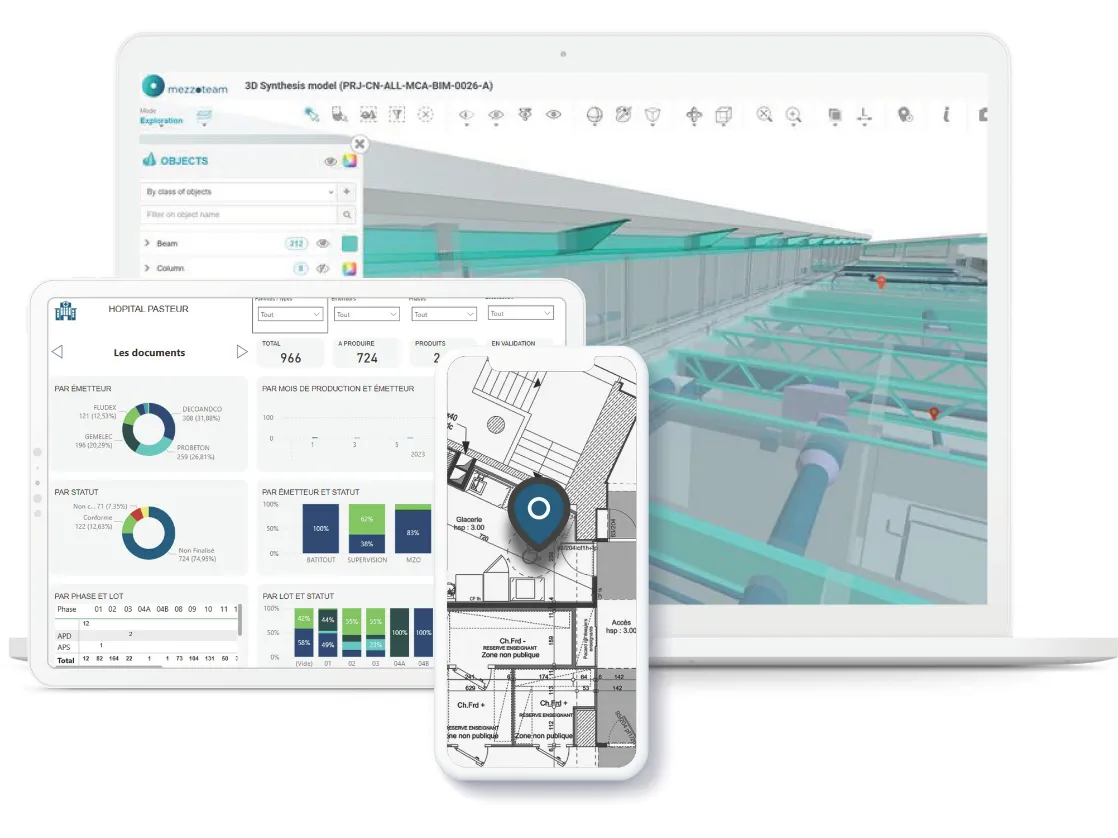
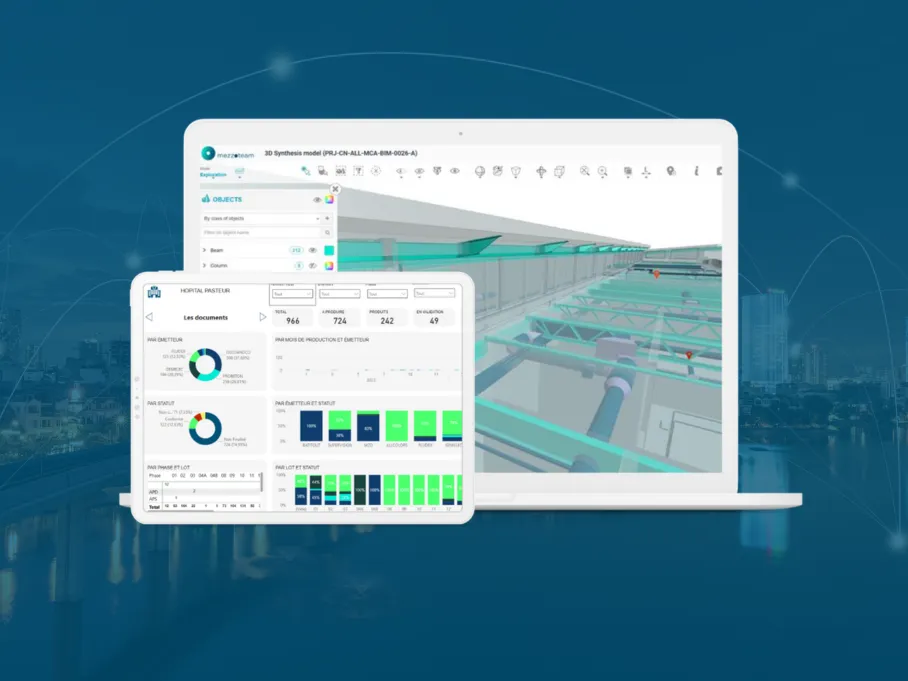
Once data is correctly collected and structured, it becomes possible to fully leverage it for operational management. Where teams once lost considerable time manually consolidating information, digital tools now allow for instant analysis thanks to visual and customizable dashboards.
Thanks to data centralization and structuring, it is now possible to track project evolution in real time. Dashboards offer a summary view, tailored to each user profile, with key indicators such as:
Actual progress compared to the initial schedule, to quickly detect delays or areas of overproduction;
The number of open punch list items, broken down by geographic zone, type of intervention, or responsible company;
The rate of completed or validated tasks, allowing for the measurement of overall site progress;
The most frequent anomalies, in order to target recurring issues and provide lasting solutions.
Ces indicateurs facilitent la prise de recul stratégique, tout en permettant un suivi très opérationnel, au jour le jour.

One of the great advantages of data analysis is that it benefits all project stakeholders. Everyone can access specific views, according to their responsibilities and needs:
Site managers track progress by lot or zone;
Engineering firms prioritize control or inspection points;
Project owners gain a consolidated view of the project with key performance indicators.
This allows every stakeholder to:
Site managers track progress by lot or zone;
Engineering firms prioritize control or inspection points;
Save valuable time when generating reports or dashboards.
Example: a dashboard displaying the 10 oldest punch list items, along with the companies involved, allows for targeted prioritization of resolutions with complete transparency. In short, data analysis transforms construction site monitoring into a true proactive management tool, focused on action and results.

Beyond delivery
In the construction sector, the majority of efforts are focused on the work phase. Yet, it is throughout the building's entire life cycle that collected data can reveal its full potential. When well-qualified, well-contextualized, and well-archived, this data becomes a strategic asset for the operation and maintenance of structures.
Field data collected with rigor—a punch list item resolved, an inspection validated, a piece of equipment checked—is not just disposable information. It represents a key element of the building's history, invaluable to the teams who will handle its operation and maintenance.
By capitalizing on this data, you facilitate:
The creation of the digital As-Built file, which gathers all documents, plans, reports, and surveys associated with the project's completion;
A seamless handover to the project owner, property manager, or facility manager, with clear access to all data useful for building operations;
The creation of a digital twin, by linking site data to the 3D model and connected systems, for smarter infrastructure management.
Cette continuité numérique garantit une meilleure traçabilité, mais aussi une transition plus fluide entre les phases chantier et exploitation, souvent marquée par une perte d’information importante.

By analyzing the history of observations, non-conformities, anomalies, or interventions, operators can go far beyond corrective or curative maintenance. They can move into a predictive maintenance approach, with concrete benefits:
Anticipate high-risk areas, by identifying equipment or zones with recurring incidents or frequent defects;
Optimize maintenance cycles, by adjusting the frequency of inspections or maintenance operations based on actual data, rather than a theoretical schedule;
Plan interventions in a more targeted way, with better resource allocation, cost reduction, and improved occupant comfort.
En résumé, bien exploiter les données de chantier, c’est préparer l’avenir du bâtiment. C’est transformer des informations issues du terrain en leviers de performance pour toute la durée de vie de l’ouvrage.

In a sector where every mistake can be costly, intelligently leveraging site data is no longer an option, but a necessity. Structuring, centralizing, and analyzing your information allows you to:
Gain responsiveness;
Improve quality and traceability;
Reduce disputes;
Anticipate future interventions.

Learn more
Discover how to centralize your data, streamline communication, and secure your project management.
Request a demo
